

Identifying Genetic Drivers of Pediatric Cancer
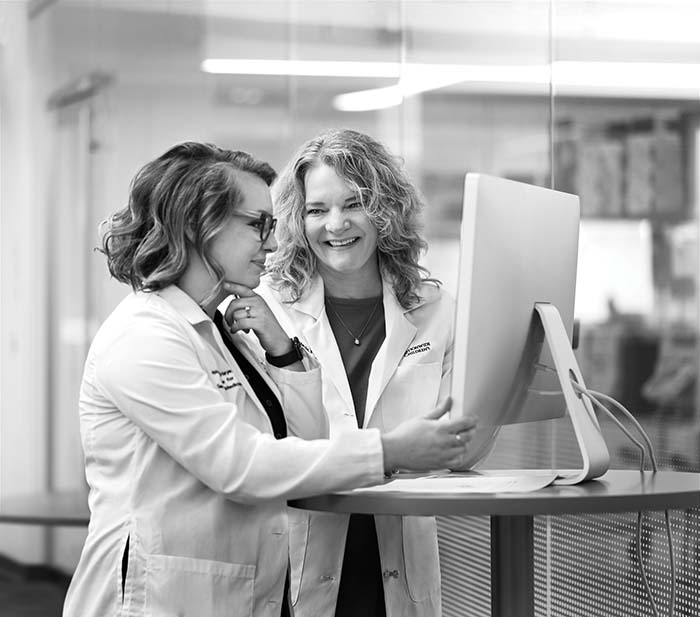
Elaine R. Mardis, PhD, co-executive director of the Steve and Cindy Rasmussen Institute for Genomic Medicine (right) and Stephanie LaHaye, PhD, postdoctoral scientist
“I think that one of the most important things we can do to help a cancer patient is to gain a more complete understanding of the intricacies underlying their specific cancer, and to use a personalized medicine approach to help guide treatment,” says Stephanie LaHaye, PhD, a postdoctoral scientist in the Steve and Cindy Rasmussen Institute for Genomic Medicine at Nationwide Children’s Hospital. “Here, we are taking a case by case approach to refine diagnosis, better understand prognosis, and identify potential targeted treatment options for these patients.”
Dr. LaHaye and her colleagues are part of a larger team of Nationwide Children’s scientists focusing on the development of the fusion detection platform. Using a multifaceted, automated, high-throughput approach to detect driver gene fusion events – chromosomal rearrangements, insertions or deletions – in patient RNA-sequencing data, researchers in the Steve and Cindy Rasmussen Institute for Genomic Medicine have identified 20 clinically meaningful fusions in 73 pediatric cancer cases so far.
“This study is expanding our ability to identify fusion genes in pediatric cancers,” says Elaine R. Mardis, PhD, co-executive director of the Institute. “This approach enables us not only to identify the fusion genes we understand already but also to discover new ones that may indicate what is driving the cancer development. In certain cases, this discovery also may indicate existing drugs that could shut down the disruptive function driving the cancer.”
“Our automated approach takes seven fusion calling algorithms and overlaps those data, allowing us to remove false positives and only focus on what we predict to be the true positives,” says Dr. LaHaye, who was awarded the Women in Cancer Research: 2019 Research Scholar Award at the 2019 American Association for Cancer Research Annual Meeting for her work on this project. “We require at least two of the seven algorithms to call the fusion for it to be output, which we then hierarchically sort based on evidence. When we identify a potentially clinically relevant fusion, we work with our colleagues in the clinical laboratory to confirm the findings.”
This information can then be used to inform the diagnosis and/or treatment of individual patients.
CITATION:
LaHaye S, Voytovich K, Schieffer K, Fitch J, Miller K, Bir N, McGrath S, Miller A, Wetzel A, Varga E, Leraas K, Agarwal V, AbdelBaki MS, Finlay JL, Leonard JR, Boue DR, Osorio D, Gastier-Foster JM, Magrini V, Cottrell CE, White P, Mardis ER, Wilson RK. Utilization of an Ensemble Approach for Identification of Driver Fusions in Pediatric Cancer. AACR 2019.


